Nikita Teryoshin
Life Sentence
The relationship between humans and animals has for centuries been shaped by projection and exploitation. In Life Sentence, Berlin-based photographer Nikita Teryoshin turns his gaze toward zoos — places whose origins are closely intertwined with Europe’s colonial past.
“I read that during the pandemic it became clear how strongly some animals reacted to the absence of human presence. Great apes often develop a close connection to humans. It was evident that they were not only accustomed to visitors, but had, in a sense, come to depend on these stimuli. That is, however, difficult to accept, because you realize they don’t belong there. This shows how unnatural these behaviors are. They are the product of a setting we created — one in which we have placed these animals and to whose conditions we have forced them to adapt.”
Once, animals were forcibly taken from distant regions; zoos functioned as windows into foreign worlds, but also as symbols of ownership and dominance. Today, they are often justified in the name of conservation. Yet what does protection truly mean when animals’ freedom is profoundly restricted and an artificial sense of proximity to humans is staged in its place.
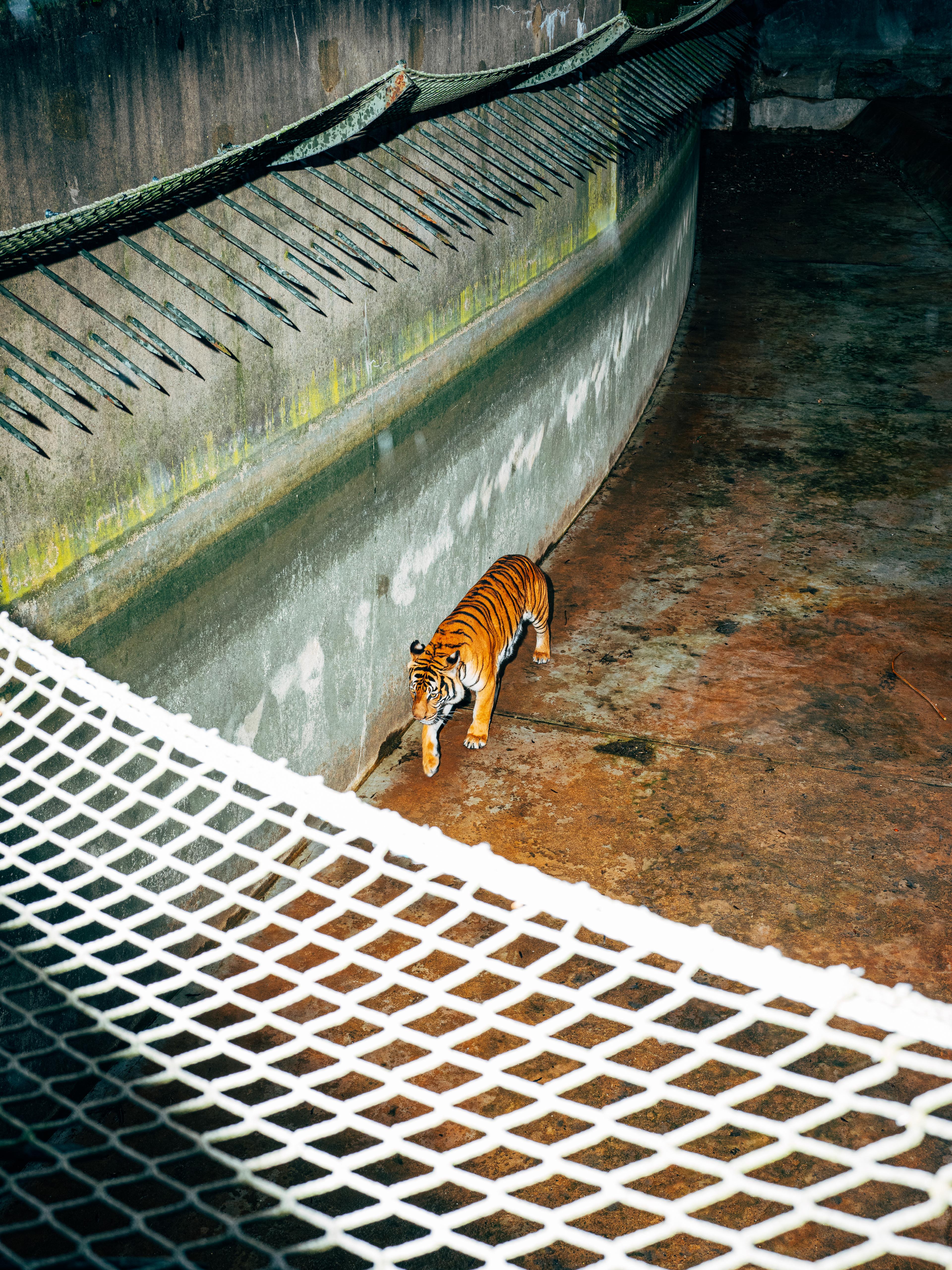
In Teryoshin’s images, the zoo appears as an artificial construct in which nature is merely simulated. The animals often seem isolated, estranged from any natural environment, confined within geometric, metallic, and concrete structures. Their bodies are dominated by these artificial spaces; their gazes appear fixed on something beyond them — something inaccessible. In that sense, the architecture itself becomes a metaphor for captivity and display.
“Whatever the animals do, they will spend their entire lives in this zoo. At best, they may one day be transferred to another zoo. But in most cases, it is the place where they are born and where they will die. This sense of life-long confinement was a central idea for me."
Again and again, visitors enter the frame. Their presence exposes the asymmetrical relationship between those who look and those who are looked at. It is from this tension that the unsettling impact of the series emerges. Some images feel quiet, almost lifeless. Others disturb through an absurdity that is never humorous. Instead, they compel viewers to reflect on the human role itself.
ABOUT THE ARTIST
Born in St. Petersburg in 1986 and based in Berlin for many years, photographer Nikita Teryoshin creates images that often appear surreal or bizarre. Through his distinctive visual language, he draws attention to subjects and events rooted in the everyday yet usually hidden from view. Early influences from his family environment shaped an artistic practice that consistently engages with structures of power, staging, and control. The relationship between humans and animals plays a central role in his work. Series such as Hornless Heritage and Animal Escape Plan examine industrial and institutional systems of animal exploitation.
Teryoshin gained international recognition with his long-term project Nothing Personal, which investigates the global arms trade and was photographed at around 20 weapons fairs in 16 countries. The project earned him the World Press Photo Award in 2020, and in 2024 the monograph Nothing Personal – The Back Office of War was published. Teryoshin’s work has been exhibited worldwide and featured in leading international publications including SZ Magazin, Die Zeit, Der Spiegel, The New Yorker, and Le Monde.
CREDITS
The exhibition was curated by Marie-Luise Mayer, Exhibitions Manager at Fotografiska Berlin, in collaboration with the artist. It was realized in partnership with IFA Berlin and in friendly cooperation with our photography print partner WhiteWall.